My socio-political blog and relevant research can be found here: http://liamfernandez.blogspot.co.nz/
Tuesday, September 24, 2013

Aaron's Socio-political final
A ban on cosmetic animal testing
New Zealand is a country which is seen as beautifully natural and flourishing with animal life. However, after first glance there is a dark side for many of the species living here. This country to its discredit, like many others, allows animals to be tested for cosmetic purposes. Unfortunately this is one issue of many falling under animal ethics in New Zealand and throughout the world. The list is too large to cover in this blog entry, so the focus of this writing, will be aimed solely on the cosmetic practice for testing products/chemicals on animals. One must be aware that the medical use for animal testing is not argued in this blog.
Cosmetic testing on animals is a business not thrust under the light of public scrutiny but practiced behind the closed doors of laboratories. There are a range of experiments used on animals to gain safer cosmetic products placed in the market. The Draize test and the LD50 test are a small example of experiments that are performed on animals today.
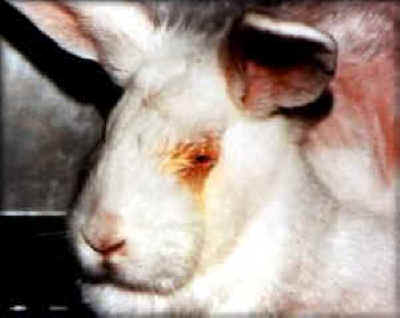
The Draize test is a prime example of an (animal) unethical experiment. Developed by John Draize, this test is performed mainly on rabbits, due to their large eyes and docile nature. A rabbit placed on a table with its head clamped (head is locked in an accessible position) and then a chemical is squirted on one eye. This process is to see whether the chemical used has an adverse reaction. The rabbit can be left with this chemical in its eye for around 14 days. Rabbits also make perfect candidates for this test as they do not produce tears to dilute the chemical.
One of the main problems with this test, outside the fact that it is cruel, creates pain and suffering for the animal, is the relevance of the chemical reaction. The rabbit eye, which has been experimented on, might produce completely different results to the same procedure being done on a human eye.
As mentioned there are a number of tests used for cosmetic products and the last that will be looked at is the LD50 acute toxicity test. Similar to the Draize test, the LD50 acute toxicity test is used to assess what dangers from a chemical or substance, over a prolonged time could have on human beings. The animals usually selected for this test are mice or rats. The animals are usually given a chemical orally and each control group is given different dosages. The animals are then observed, this is to gauge what affects different levels of the chemical have on the subject. The dosages are continually given until a certain number of subjects are deceased. However, one death is not a viable statistic, as Prof, E. Walum states,
“The LD50 value, defined as the statistically derived dose that, when administered in an acute toxicity test, is expected to cause death in 50% of the treated animals in a given period…”
Again the LD50 test falls under the same scrutiny as the Draize test. The lack of relation between human physiology and mice/rat physiology, also their comparability in toxic sensitivity, is a large hole in the tests design. Yet it is still used in experiments preformed today.
For an individual to be saved from a horrible disease, by a drug which has been tested on an animal, is harder to argue. However, the pain and suffering an animal has to go through so human vanity can be sustained is unjustifiable. Many countries throughout the world are ahead of New Zealand in this regard. Countries throughout the EU, as of March 26th 2013, have banned all sales on products developed by being tested on animals. The United Kingdom has also followed the example set by the EU.
Animal testing (caution can be disturbing viewing.)
There are still countries, like New Zealand, which demand cosmetic companies wanting to sell throughout its boarders, that all products must be tested and regulated by animal experimentation. One good example is China. With a large market and increased sales of cosmetics, it is hard to see any of the larger more well-known brands pushing out of China.
New Zealand, China and other counties that still allow cosmetic testing on animals should be focused on the study of alternate methods. They exist and are used throughout EU, Japan, Australia and many more. There is new research in growing human skin cells and fully replicating skin for skin irritation tests. For acutely toxic chemicals there is computer screening techniques know as (Q)SARS. Though they may not be able to scan all available chemicals they would reduce the need for animal tests considerably, effectively lowering numbers of animals needed to be used. This should be the minimum goal all countries that still continue old testing methods. There have been large advancements in vitro and in silico tests, (in vitro meaning in glass) and (in silico meaning performed on a computer.) Techniques are still in need of finalization but the need for complete disuse of animal experimentation is vital.
Alternative non-animal testing methods.
As previously mentioned well-known cosmetic companies that still cling to animal testing are being sold in New Zealand, brands such as Avon products, 3M, Gillette, L’Oreal, Herbal Essences and many others. The best way to help cripple the cruel side of the beauty industry, is to lower their profit margins, this is done simply by not purchasing their products. Organisations such as PETA give lists on companies regarding cosmetics companies and their values on animal ethics. Also any product with the logo of The Leaping Bunny on it is ethically sound.
There is a list from PETA, which displays companies that do not test their products on animals and these companies continue to prove the change in the industry is possible. PETA has another list of companies that do test their products on animals and unfortunately many of the names will be familiar.
For animals to be treated fairly and for what is an urgent issue that needs to be resolved, the scientific community needs to stand behind animal ethics. They are the ones who will dicover new and life saving alternate methods. They are the people who are in the position of power. They are the people that are able to treat or mistreat these animals.
Liam's Socio-political Links and References
You can find these links and more on my Delicoius Page.

(Web Article) Another kick in the pants for New Zealand's 'smiling zombies' by Andrew Stone. http://www.nzherald.co.nz/lifestyle/news/article.cfm?c_id=6&objectid=10797098 (Discusses Gordon McLauchlan's The Passionless People Revisited: New Zealanders in the 21st Century).
(Web article/Interview) Gordon McLauchlan produces Passionless People sequel by DIANA DEKKER. http://www.stuff.co.nz/dominion-post/culture/6742579/Gordon-McLauchlan-produces-Passionless-People-sequel (Reviews Gordon McLauchlan's The Passionless People Revisited: New Zealanders in the 21st Century. Includes telephone interview with the author).
(Web video) CULTURAL ICONS - Conversations with iconic people: Episode 37 http://culturalicons.co.nz/episode/gordon-mclauchlan (Video: A Discussion between Gordon McLauchlan and Hamish Keith)
(Opinion blog entry/article) Karl du Fresne and The Passionless People by LJ Holden
http://www.republic.org.nz/blog/karl-du-fresne-and-passionless-people (Blog entry discussing Gordon McLauchlan's The Passionless People Revisited: New Zealanders in the 21st Century and Karl du Fresne's The current system works - end of story).
(Web image) The six o'clock swill http://www.teara.govt.nz/en/cartoon/40680/the-six-oclock-swill (Cartoon of the six o'clock swill by Nevile Lodge, late 1940's)
(Web info) Understanding New Zealand national identity http://www.teara.govt.nz/en/new-zealand-identity/page-1 (Info on identity in NZ).
(Web info) Alcohol http://www.teara.govt.nz/en/alcohol/page-1 (The history of alcohol in NZ including its colonial introduction and binging).
(Web info) Drinking patterns and social impacts http://www.teara.govt.nz/en/alcohol/page-5 (looks at the social impact of alcohol in NZ along with binge culture and action taken).
(Digital book) Reading Pakeha?: Fiction and Identity in Aotearoa New Zealand by Christina Stachurski. http://books.google.co.nz/books?id=Or8llrJe7VAC&pg=PA1&lpg=PA1&dq=Phillips,+Jock.+A+man%E2%80%99s+country?:+the+image+of+the+pakeha+male,+a+history.+Auckland:+Penguin,+1996.&source=bl&ots=oD5o53fI6K&sig=DXDGu2g24Fx5jioRREM3JPK2qpk&hl=en&sa=X&ei=kBsdUpTKGYbxkAX-tIHYBA&ved=0CE8Q6AEwBg#v=onepage&q=Phillips%2C%20Jock.%20A%20man%E2%80%99s%20country%3F%3A%20the%20image%20of%20the%20pakeha%20male%2C%20a%20history.%20Auckland%3A%20Penguin%2C%201996.&f=false (Academic writing on Pakeha identity in NZ).
(Book) Phillips, Jock. A man’s country?: the image of the pakeha male, a history. Auckland: Penguin, 1996. (traces the history and shifts of how New Zealanders believe their white male members should act and think).
(Blog article) Legacy of the six o'clock swill by RICHARD BOOCK http://www.stuff.co.nz/auckland/blogs/an-auckland-minute/7556343/Legacy-of-the-six-o-clock-swill (blog article on the lasting affects of the 'six o'clock swill' in the 1960's).
(Television Interview) Q+A: Susan Wood interviews Nick Cater. http://www.scoop.co.nz/stories/PO1307/S00159/qa-susan-wood-interviews-nick-cater.htm (Transcript of an interview which looks at the loss of that great egalitarian Australian society, and whether there are comparisions to NZ). Q + A – 14 July, 2013
Plato. (2013). The Biography Channel website. Retrieved 07:39, Sep 27, 2013, from http://www.biography.com/people/plato-9442588
TVNZ. (N.D). About Fair Go. Retrieved from: http://tvnz.co.nz/view/tvone_minisite_story_skin/414441
Rosenberg, B. (2011). Inequality in New Zealand - How Bad? Does it matter? What can we do about it? Wellington: New Zealand Council of Trade Unions.
Bramhall, S. (2010, January 26). In New Zealand They Call It Rogernomics [Blog Entry]. Retrieved from URL: http://stuartbramhall.aegauthorblogs.com/2010/01/26/in-new-zealand-they-call-it-rogernomics/
Minto, J. (2010). Inequality linked to social problems. Retrieved from URL http://www.stuff.co.nz/business/blogs/frontline/4380261/Inequality-linked-to-social-problems
Hanley, L. (2009). The way we live now. Retrieved from URL http://www.theguardian.com/books/2009/mar/13/the-spirit-level
TV3. (n.d.). Inside Child Poverty: A Special Report. Retrieved from URL http://www.tv3.co.nz/Shows/InsideNZ/InsideChildPovertyASpecialReport.aspx
Bruce, B. (2013). INSIDE NEW ZEALAND: Mind the Gap [Television Documentary]. New Zealand: Red Sky Film & Television Ltd.
G20 inequality rises as trickle down effect fails poorest. (2012). Retrieved from URL http://www.oxfam.org.nz/news/g20-inequality-rises-as-trickle-down-effect-fails-poorest
Robin Hood Tax. (n.d). The Big Idea. Retrieved from URL http://www.robinhoodtax.org/how-it-works
Hickey, B. (2013). OECD calls on NZ to implement Capital Gains Tax and land tax to improve savings and investment habits; also wants deposit insurance scheme and higher capital for banks. Retrieved from URL http://www.interest.co.nz/property/64761/oecd-calls-nz-implement-capital-gains-tax-and-land-tax-improve-savings-and-investment
Cooperative Business New Zealand. (n.d). Understanding Co-ops. Retrieved from URL http://www.nz.coop/understanding-co-ops/
Price, K., & Folsom, E. (1995-1998). About Walt Whitman. Retrieved from URL http://www.english.illinois.edu/maps/poets/s_z/whitman/bio.htm
Wilkinson, R., & Pickett, K. (2009). The Spirit Level - Why Greater Equality Makes Societies Stronger. New York: Bloomsbury Press.
McLauchlan, G. (2012). The Passionless People Revisited. Auckland: David Bateman Ltd.
Images and video retrieved from:

Rosenberg, B. (2011). Inequality in New Zealand - How Bad? Does it matter? What can we do about it? Wellington: New Zealand Council of Trade Unions.
Wilkinson, R., & Pickett, K. (2009). The Spirit Level - Why Greater Equality Makes Societies Stronger. New York: Bloomsbury Press.
Monday, September 23, 2013
Monday, September 9, 2013
Jess - pro choice links
(Youtube video)
Watching this video did create feelings of anger, it
is important to understand the other viewpoint of your argument and the 7 questions
asked in the video are commonly used as pro life arguments.
youtube.com
(Opinion blog entry/article)
Clear and concise argument points for pro choice.
buzzle.com
(Opion blog entry/article)
It was helpful for me to read some other peoples essays on pro choice vs pro life, it gives you an idea of what is commonly argued.
ultius.com
(Web article)
Another essay debating pro life vs pro choice, it had different points from the previous.
carmelunified.org
(Web article)
Biased websites and articles give you an indepth look into the arguement as well as presenting other sources and works cited.
amplifyyourvoice.org
(Blog entry)
Considered a blog entry as the website is run by one contributor.
whyprolife.com
(web info)
Explains the debate for some one who is unsure of the details or terms mentioned
about.com
(Blog entry)
policymic.com
(Online news article)
lifenews.com
(online news article)
gazettenet.com
(blog entry)
christianpost.com
Tuesday, September 3, 2013
Socio political issue links-Chuer Feng
http://www.nzherald.co.nz/northland-age/opinion/news/article.cfm?c_id=1503399&objectid=11118702
(Web Article) Clearing the NZ's fonterra botulism issue.
http://www.nzherald.co.nz/northern-advocate/rural/news/article.cfm?c_id=1503445&objectid=11118279
(web article) Dairy payout targeted to debt.
http://www.fao.org/docrep/011/i0588e/i0588e04.htm
(web article)
http://www.chinadaily.com.cn/business/2013-09/03/content_16939241.htm
(Statistics of dairy companies)
http://www.stuff.co.nz/dominion-post/news/7387776/Customer-abuses-staff-over-baby-milk-limit
(web article)
http://www.nzherald.co.nz/nz/news/article.cfm?c_id=1&objectid=10719682
(web article) China buys up big in NZ baby milk.
http://www.nzherald.co.nz/business/news/article.cfm?c_id=3&objectid=10890692
(web article) NZ supermarkets supply formula used in black market.
http://www.nzherald.co.nz/northern-advocate/rural/news/article.cfm?c_id=1503445&objectid=11118279
(web article)
http://www.nzherald.co.nz/nz/news/article.cfm?c_id=1&objectid=10720286
(web article)
http://www.nzherald.co.nz/business/news/article.cfm?c_id=3&objectid=10620384
(web article)
(Web Article) Clearing the NZ's fonterra botulism issue.
http://www.nzherald.co.nz/northern-advocate/rural/news/article.cfm?c_id=1503445&objectid=11118279
(web article) Dairy payout targeted to debt.
http://www.fao.org/docrep/011/i0588e/i0588e04.htm
(web article)
http://www.chinadaily.com.cn/business/2013-09/03/content_16939241.htm
(Statistics of dairy companies)
http://www.stuff.co.nz/dominion-post/news/7387776/Customer-abuses-staff-over-baby-milk-limit
(web article)
http://www.nzherald.co.nz/nz/news/article.cfm?c_id=1&objectid=10719682
(web article) China buys up big in NZ baby milk.
http://www.nzherald.co.nz/business/news/article.cfm?c_id=3&objectid=10890692
(web article) NZ supermarkets supply formula used in black market.
http://www.nzherald.co.nz/northern-advocate/rural/news/article.cfm?c_id=1503445&objectid=11118279
(web article)
http://www.nzherald.co.nz/nz/news/article.cfm?c_id=1&objectid=10720286
(web article)
http://www.nzherald.co.nz/business/news/article.cfm?c_id=3&objectid=10620384
(web article)
Subscribe to:
Posts (Atom)